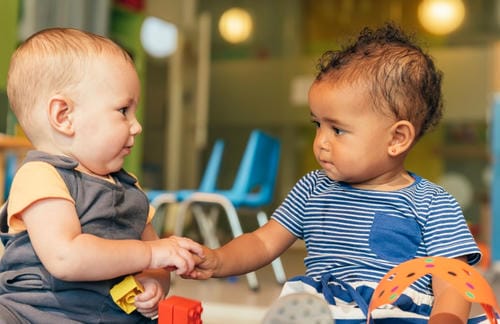
Every parent is familiar with the moments before their baby speaks their first clear word — the coos, the smiles, the gaze that seems to say “look at this,” and the wide-eyed fascination with a caregiver’s face. These early behaviors are not random or merely reflexive; they are the infant’s first steps into the world of communication. Long before a child can articulate “mama” or “dada,” they are deeply engaged in what researchers call preverbal communication, a dynamic process by which infants and caregivers interact through sound, gesture, eye contact, and shared attention. This foundational period is a phase of rapid development in which babies learn the rhythms of back-and-forth interaction, the social cues that underlie language, and the basic purposes of communication itself. In fact, infants show a distinct preference for human voices and faces from birth, and over the first months of life, they increasingly participate in intentional communicative exchanges that set the stage for later vocabulary growth and language skills. These early interactions are not simply the precursor to speech; they are the architecture upon which language is built, illustrating that communication begins well before spoken words emerge.
The Dynamics of Preverbal Communication
From the moment a child is born, communication begins without words. Long before a baby speaks recognizable vocabulary, they are actively engaged in learning how to communicate through a rich array of preverbal behaviors. These early interactions form the foundation for later language ability, and research increasingly shows that infants’ communicative actions — such as eye contact, vocalizations, gestures, and shared attention — are far from random noise. Instead, these behaviors reflect purposeful social engagement and emerging communicative intent. A longitudinal study by researchers from the University of Sheffield and collaborating institutions found that babies as young as 11 to 12 months who vocalize while making eye contact with caregivers are more likely to develop larger vocabularies later on, highlighting that even seemingly simple preverbal acts are meaningful in language development. The study emphasizes that infants can “get you to talk to them” before they can actually produce words, and that caregiver responses to these early communicative bids significantly influence language growth. [1]
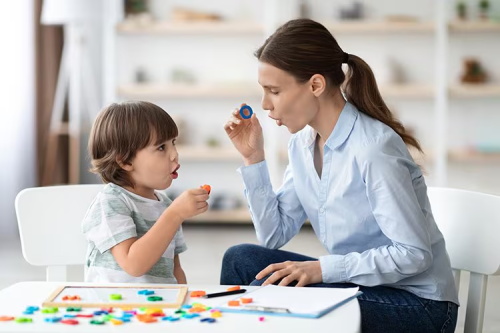
Infants begin life using a range of nonverbal signals — from reflexive cries that indicate discomfort or hunger to coos and gurgles that invite social engagement. These early sounds evolve into more complex vocalizations as infants gain control over their vocal tract and practice the rhythms of speech. Even before spoken language emerges, babies are tuning into the structure of language: they learn to recognize patterns, anticipate conversational turn-taking, and map attention between faces and objects. By engaging in what caregivers often refer to as “baby talk” or “parentese” — a high-pitched, rhythmic style of speech — adults help infants focus on linguistic patterns and emotional content, scaffolding the early stages of language processing. These interactions do more than entertain; they robustly activate regions of the infant brain associated with attention and social cognition, which in turn supports emerging language skills. [2]
A growing body of neuroscience research also supports the importance of these social engagements in preverbal communication. Studies using safe, noninvasive techniques like magnetoencephalography reveal that when infants engage in face-to-face, socially contingent interactions with adults, there is increased neural activity in brain regions linked to attention and sensorimotor processing — activity that has been shown to predict later language outcomes beyond infancy. In contrast, when the social component is absent, such as when an adult’s attention is directed elsewhere, infants’ brains do not show the same patterns of engagement. These findings underscore that the quality of early interaction — not just the exposure to language — is a key driver of linguistic development.
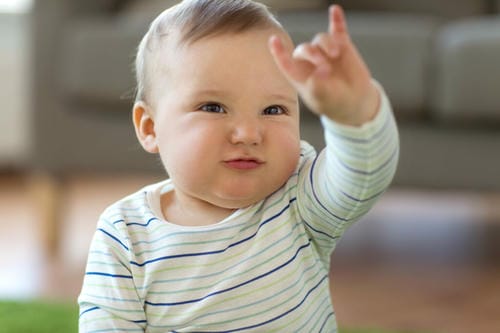
Crucially, preverbal communication is not limited to sound. Gestures such as pointing, reaching, or showing an object are powerful tools that infants use to direct adult attention and solicit responses. Research in developmental psychology indicates that these gestures are not mere precursors to language; they play a critical role in how infants learn the referential nature of words. When infants point to an object of interest, caregivers are more likely to provide tailored linguistic input — naming the object, describing its attributes, or narrating the context — which enhances the infant’s ability to link sounds with meanings. This “guided exposure” facilitates language learning by aligning caregivers’ speech with the infant’s attention and interests. [3]
Another compelling aspect of preverbal communication is infants’ capacity to interpret the communicative interactions of others. Research on communicative “mind-reading” suggests that nonverbal infants, around 13 months of age, can infer meaningful information from observed exchanges between third parties. In these studies, infants interpret sequences of sounds between agents as communicative acts that convey context-relevant information, an ability that points to an innate sensitivity to the structure and purpose of communication even before the onset of spoken words. This capacity for socially interpreting communication reinforces the notion that language learning is deeply rooted in social cognition.
The Central Role of Interaction in Language Growth
Understanding how infants learn communication before words requires appreciating the pivotal function of social interaction. Daily back-and-forth exchanges between infants and caregivers do more than transmit vocabulary; they shape the neural and cognitive architecture for language itself. Responsive parents and caregivers who tune into infants’ cues — such as changes in gaze, vocalizations, or gestures — and actively engage in reciprocal communication provide an environment rich in social information and linguistic opportunity. According to a systematic review of infant social interactions and brain development, social behaviors in infancy are associated with measurable neural responses, and these early relational patterns can exert long-term effects on developmental trajectories well into later childhood.
One key aspect of early interaction is joint attention — periods when caregiver and infant are both focused on the same object or event. Joint attention episodes are powerful learning contexts because they anchor language input to shared experiences. When a caregiver labels an object that both are attending to, infants are more likely to form associations between words and their referents, strengthening word learning before they can articulate those words themselves. Research shows that infants as young as nine months are already capable of using gaze behavior to map words onto objects, demonstrating that the cognitive underpinnings of referential learning emerge before active speech. [4]
Preverbal social engagement also entails infants’ sensitivity to communicative intent and context. Studies on early memory processes indicate that infants allocate their limited cognitive resources differently depending on whether a context is perceived as communicative. When information is presented in an interactive, communicative setting, infants devote more attention to relevant aspects — such as the identity of objects — compared with noncommunicative contexts where neural engagement is not framed as social interaction. This bias reflects an early understanding of the purposefulness of communication and suggests that infants are not passive recipients of language input but active interpreters of social information.
Furthermore, emerging evidence highlights that early social communication patterns can inform clinical understanding of developmental differences. For example, studies examining infants later diagnosed with autism spectrum disorder reveal that markers of social communication — including eye gaze, facial expression, gestures, and prelinguistic sounds — show measurable differences by as early as nine months of age. These findings suggest that the complex interplay between social engagement and communication is not only foundational to typical language learning but also provides insight into developmental trajectories that may benefit from early intervention.
Collectively, this body of research paints a picture of language development that begins long before the first spoken word. Infants are biologically attuned to social interaction, and through dynamic, reciprocal engagement with caregivers and others, they build the cognitive, neural, and social foundations of communication. The preverbal period is thus not a silent waiting room before language; it is an active phase of exploration, exchange, and learning, where infants are continually constructing the frameworks that will support fluent language use in the years to come.
Sources:
[1]: https://sheffield.ac.uk/psychology/news/scientists-reveal-early-behaviours-best-predict-childs-language-ability
[2]: https://www.washington.edu/news/2024/04/08/everyday-social-interactions-predict-language-development-in-infants
[3]: https://academic.oup.com/chidev/article/89/3/941/8263328
[4]: https://www.sciencedirect.com/science/article/pii/S0163638325001286
References:
https://pubmed.ncbi.nlm.nih.gov/34786700