
Pacifiers are among the most frequently used soothing tools that caregivers provide newborns and infants. For many families, offering a pacifier becomes a simple way to calm a fussing baby, establish sleep routines, and moderate stress in both infants and caregivers. The act of non-nutritive sucking — which includes pacifier use — taps into an innate reflex present in infants that can provide immediate comfort and reduce crying intensity. Unlike nutritive sucking involved in feeding, non-nutritive sucking does not provide calories but offers sensory input that many infants find reassuring. This reflex is prominent early in life and has clinical value in settings such as neonatal care, where controlled non-nutritive sucking can help premature infants develop feeding skills and regulate physiological responses. The soothing effect of pacifiers also influences parental stress and caregiving dynamics, with some studies indicating that parents report lower levels of stress and more positive perceptions of their infant’s affect when pacifiers are used.
Pacifier Use and Its Relation to Early Development
At the same time, modern developmental science increasingly emphasizes that infancy and toddlerhood are critical periods for building the neural foundations of language and cognition. During the first years of life, infants rapidly develop oral motor skills, social communication capacities, and vocabulary knowledge through repeated interactions with caregivers. These interactive behaviors — including cooing, babbling, lip movement, and responsive vocal exchange — contribute to shaping neural circuits that support later language, social, and cognitive functioning. Because pacifiers occupy the mouth and require sustained non-nutritive sucking, researchers have questioned whether extended pacifier use could influence opportunities for infants to practice these essential oral motor and communicative behaviors. This concern has driven research that examines possible connections between pacifier use and aspects of early neurodevelopment, including vocabulary size, speech motor planning, and cognitive outcomes. [1]
Although pacifier use can provide immediate emotional and regulatory benefits, the question of whether its extended use affects long-term neurodevelopment — particularly in language and cognitive domains — reflects a complex interplay of behavioral, structural, and environmental factors. For example, research exploring pacifier exposure over time has observed associations with smaller vocabulary sizes and altered language processing in some samples, especially when pacifiers are used intensely or beyond the age of early toddlerhood. These findings have prompted careful discussion among pediatricians, speech-language pathologists, and developmental researchers about how to balance the short-term benefits of pacifier use with sensitive timing for weaning and promoting developmental opportunities that support oral motor and communicative growth.
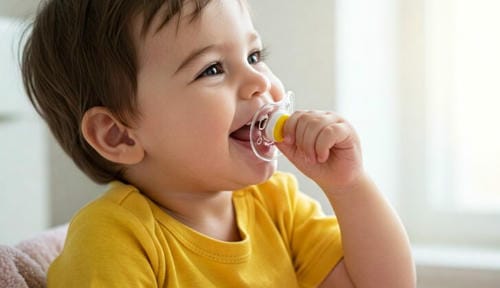
Effects of Prolonged Pacifier Use on Language, Cognition, and Oral Motor Skills
One critical area of concern in the neurodevelopmental literature is the relationship between extended pacifier use and speech and language outcomes. Infants and toddlers who use pacifiers extensively — particularly past the ages of two or three — appear to have higher odds of speech-related difficulties compared with children who use pacifiers for shorter durations. Longer non-nutritive sucking habits have been associated with increased rates of speech disorders, potentially due to limitations in practicing oral motor movements necessary for articulate speech. [2]
Multiple research studies support this connection. For example, evidence indicates that intense and prolonged pacifier use can contribute to raised or indented palates and changes in oral cavity structure, which may interfere with normal articulation. These oral structure changes can restrict tongue and lip movements that are essential for forming and producing speech sounds, particularly during the first three years of life — a period identified as critical for language acquisition and oral motor development.
Beyond anatomical considerations, pacifier use may influence early vocabulary development and broader cognitive outcomes. Some longitudinal research suggests that children with extensive pacifier exposure during infancy — especially when use continues into later toddlerhood — exhibit smaller vocabulary sizes at 12 and 24 months of age compared with peers with limited pacifier use. Intense daytime pacifier use has also been linked to lower cognitive scores, including IQ measures assessed at school age, with evidence pointing toward a dose–response relationship wherein longer and more frequent usage corresponds to greater developmental impact.
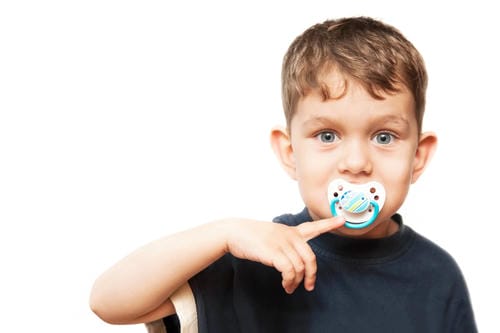
The mechanisms underlying these associations are multifaceted. From a behavioral perspective, infants who frequently have pacifiers in their mouths may have fewer opportunities to engage in spontaneous vocalization and interactive communication with caregivers — both of which are foundational to language learning. By contrast, children who are often engaged in cooing, babbling, and responsive interaction build neural networks tied to expressive and receptive language skills. Limiting opportunities for such exchange may subtly delay or alter the trajectory of language acquisition. Additionally, reduced oral motor practice due to pacifier use could delay development of muscle coordination necessary for speech production. [3]
It is important to emphasize that not all research reports unequivocal negative outcomes tied to pacifier use. Some studies have found that general speech outcomes are not significantly associated with pacifier use except in the context of very high levels of use, such as prolonged daytime sucking or use beyond age three. The variation in study findings underscores that pacifier effects are often related to frequency and duration, rather than a simple yes/no issue.
In addition to language and cognition, prolonged pacifier use has been associated with physical changes in oral and facial structures that may indirectly influence developmental pathways. Extended non-nutritive sucking can contribute to malocclusions — dental alignment issues such as open bites and crossbites — as well as changes in jaw growth and palate shape. These structural differences may not directly reflect neurodevelopmental processes but can affect speech articulation, feeding patterns, and self-confidence in communication skills as children grow older.

Navigating Pacifier Use: Balancing Benefits and Developmental Factors
Given the mixed nature of the evidence, health professionals and parents are increasingly focused on strategies that balance the soothing benefits of pacifiers with an awareness of potential developmental considerations. Many pediatricians recommend limiting pacifier use to sleep and brief soothing periods during the first year of life. After age one, gradually reducing pacifier dependence can help minimize risks associated with prolonged pacifier exposure. Early weaning — ideally before age two — is often advised to promote greater opportunities for speech practice, oral motor development, and interactive communication without reliance on non-nutritive sucking. [4]
Parent-child engagement beyond pacifier use plays a central role in healthy neurodevelopment. Encouraging responsive interaction, reading aloud, and providing environments rich in verbal exchange supports language acquisition and cognitive growth. In cases where pacifier use persists or where parents have concerns about speech milestones or oral motor development, consultation with pediatric specialists — including speech-language pathologists or pediatric dentists — can provide tailored guidance.
Sources:
[1]: https://www.mayoclinic.org/healthy-lifestyle/infant-and-toddler-health/in-depth/pacifiers/art-20048140
[2]: https://link.springer.com/article/10.1186/1471-2431-9-66
[3]: https://www.speakeasytherapy.org/post/prolonged-pacifier-use-how-can-it-affect-speech-language-development
[4]: https://www.mayoclinic.org/healthy-lifestyle/infant-and-toddler-health/in-depth/pacifiers/art-20048140
References:
https://pubmed.ncbi.nlm.nih.gov/38445061
https://www.frontiersin.org/journals/psychology/articles/10.3389/fpsyg.2024.1349323/full
https://www.mdpi.com/2227-9067/11/11/1353