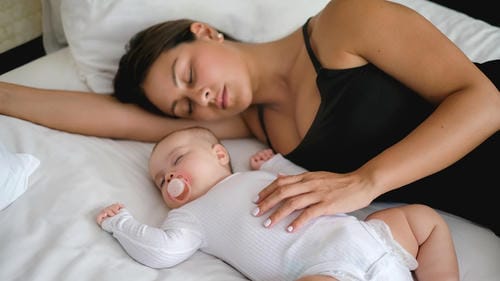
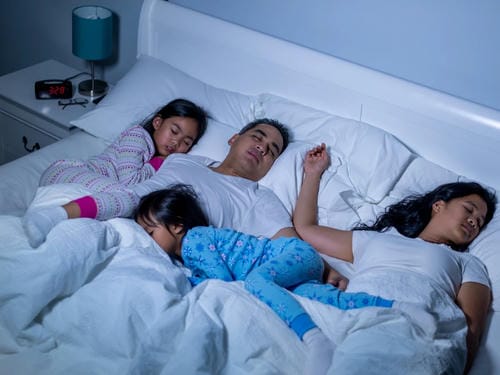
Sleep is a universal human experience, but how families structure sleep — especially for infants and young children — is deeply shaped by cultural values, social norms, and practical living conditions. Around the world, there is extensive diversity in how caregivers and children rest at night: practices range from infants sleeping alone in a separate room to families sharing the same bed or room well into childhood. Understanding these practices helps parents contextualize their own family decisions and appreciate the cultural logic behind different approaches to co-sleeping. Research shows that in many parts of the world, co-sleeping — often including bed-sharing or room-sharing — is the norm rather than the exception. In Asia, Africa, and Latin America, co-sleeping with infants is widespread and seen as a continuation of daytime caregiving into the night, reinforcing family unity and emotional closeness. In Japan, for example, the practice known as kawa no ji — meaning “river” — symbolizes the close arrangement of child between parents on a shared sleep surface, and many children sleep alongside parents well into early childhood. Similar practices exist in Thailand and Hong Kong, where a large majority of families share a sleep space, and these regions are also noted for relatively low rates of sudden infant death syndrome (SIDS), although multiple factors influence those statistics. Ethnographic and anthropological surveys indicate that of cultures with reliable data on infant sleeping proximity, a significant majority place infants in sensory proximity to caregivers, with two-thirds of cultures in some samples practicing mother-infant bed-sharing.
Across many African and South American communities, sleeping together is not simply a caregiving choice but a deeply embedded cultural expectation. In some places, leaving an infant to sleep alone is viewed as unusual or even emotionally difficult for caregivers and children alike. Traditional homes, extended family structures, and communal sleeping spaces also contribute to the prevalence of co-sleeping in non-Western contexts. The reasoning often reflects a worldview where the physical presence of caregivers at night supports safety, comfort, and emotional security for children, and where sleep is integrated into the rhythms of family life rather than treated as an individual function. In many such societies, co-sleeping extends beyond infancy, with siblings and extended family members also sharing sleeping spaces. Communities with habitual co-sleeping, including some hunter-gatherer societies, reflect patterns in which most adults and children share a sleeping surface within a communal hut, indicating that close nighttime proximity among family members is not just common but normative in a wide range of human groups. [1]
In contrast, many Western nations — including the United States, parts of Canada, and some Western European countries — promote independent sleep for infants and children as part of a broader cultural emphasis on individual autonomy and self-soothing. In these contexts, caregivers frequently use separate sleep surfaces, such as cribs, bassinets, or beds in a different room, with the expectation that infants will learn to sleep alone at an early age. While data from the United States indicate that many parents do co-sleep with their infants at least some of the time, societal norms and pediatric guidance often favor room-sharing without bed-sharing or early transitions to solitary sleep. Pediatric health campaigns, such as the “Safe to Sleep” initiative in the U.S., emphasize safe sleep practices that aim to reduce SIDS risk by promoting supine sleep positions and specific sleep environments, reflecting particular cultural priorities about safety and developmental independence.
Parents in Western societies may therefore face conflicting messages: cultural norms that valorize independence — and sometimes stigmatize co-sleeping — juxtaposed with parents’ own instincts for physical closeness and on-demand caregiving. Research underscores that these cultural messages significantly influence parental choices; for example, systematic reviews show that encouraging attitudes from extended family and cultural tradition increase the likelihood of co-sleeping, while discouraging messages from healthcare professionals can lead to parental anxiety, social conflict, or reluctance to discuss sleep practices with medical providers. In some European contexts, such as Sweden and other Scandinavian countries, co-sleeping remains a culturally accepted practice, with families often viewing shared sleep as unremarkable and compatible with broader goals of responsive, gentle parenting. These examples illustrate that even within broadly Western cultural spheres, there are significant variations in how sleep practices are interpreted and valued, shaped by intersecting cultural logic, health guidance, and family priorities. [2]

Cultural Logic and the Meanings of Sleep Practices
The global variation in sleep arrangements is not random but rooted in differing cultural logic about caregiving, autonomy, and the family’s role in child development. In many non-Western cultures, co-sleeping is viewed as a natural extension of caregiving: closeness at night facilitates breastfeeding, enables rapid response to infant needs, and reinforces emotional bonds. Shared sleep spaces also reflect practical considerations, such as housing that accommodates multiple family members in a single room and collective child-rearing traditions where extended family support is integral. In these contexts, co-sleeping is tied to broader values of interdependence and communal life, where family members’ physical proximity throughout the day and night signifies collective responsibility for children’s wellbeing. [3] Conversely, in cultural frameworks that prioritize individual self-reliance and early autonomy, solitary sleep arrangements are celebrated as developmental milestones, and infants’ ability to transition to independent sleep is interpreted as a marker of progress. These cultural norms influence not only parental decisions but also the social reception of those decisions: families who diverge from dominant local practices — whether choosing co-sleeping in a culture that favors independence or solitary sleep in a culture that favors closeness — often encounter social feedback that reflects broader cultural attitudes about child-rearing. Researchers note that when parents do not conform to culturally prescribed sleep practices, they are more likely to experience criticism, stress, or conflict within families or with healthcare professionals, highlighting how deeply cultural schemas about sleep shape both caregiving practices and parents’ emotional experiences. By recognizing the diverse cultural logics that underpin sleep practices around the world, parents can better understand the range of normative models that exist and the social meanings attached to each. [4]
Sources:
[1]: https://www.naturalchild.org/articles/james_mckenna/cosleeping_world.html
[2]: https://pubmed.ncbi.nlm.nih.gov/38837802
[3]: https://link.springer.com/rwe/10.1007/978-3-319-19650-3_799
[4]: https://www.longdom.org/open-access/crosscultural-sleep-in-infants-exploring-diverse-practices-and-their-implications-109311.html
References:
https://shunchild.com/article/is-co-sleeping-with-your-baby-common-around-the-world
https://www.besjournal.com/en/article/doi/10.3967/bes2022.031