Emotional intelligence (EI), sometimes called emotional quotient (EQ), is a child’s ability to recognize, understand, manage, and respond to emotions — both their own and those of others. This is not an abstract concept; developmental psychologists describe it as a set of competencies that directly influence how children interact with peers, cope with stress, and engage with learning environments. EI includes core skills such as emotional awareness, emotional regulation, empathy, motivation, and social interaction. Research shows that these competencies can be nurtured intentionally rather than emerging automatically as children age. Integrating EI into everyday learning is typically done through what educators and researchers call social-emotional learning (SEL), a framework that focuses on five core competencies: self-awareness, self-management, social awareness, relationship skills, and responsible decision-making. SEL programs deliberately teach children to pause, reflect on their feelings, understand emotional cues, and make thoughtful choices. This framework is supported by decades of developmental research indicating that emotional intelligence is connected to healthier social behaviors, emotional regulation capacities, and cognitive outcomes — benefits that are observable from early childhood through adolescence. By approaching EI as a learnable and teachable set of skills, parents can see that emotional development is not solely the product of temperament or innate personality but is shaped by interactions, modeling, and the caregiving environment. [1]
Scientific literature underscores that EI/EQ in children is linked not just to better emotional experiences but also to broader developmental advantages. According to child development specialists, children who can accurately identify what they are feeling are better equipped to express needs and wants in constructive ways and are less prone to outbursts or misdirected behavior. Importantly, these competencies support a child’s social-interaction repertoire — emotionally intelligent children tend to be more empathetic, cooperative, and resilient when facing challenges. Children who can regulate emotions effectively are also more likely to navigate interpersonal conflicts with peers productively. As children grow, these foundational emotional skills continue to support more complex emotional tasks, such as perspective-taking and conflict resolution. Additionally, the capacity to manage emotions correlates with mental well-being markers, such as lower anxiety and improved self-confidence, making EI a critical contributor to a child’s overall psychological resilience as they mature.
Importantly, research emphasizes that emotional intelligence is observable and measurable in childhood. Studies indicate that universal SEL interventions — structured curricula delivered in early education settings — are directly associated with enhanced emotional competence, improved social skills, reduced behavioral challenges, and stronger academic performance over time. These gains are not random or transient; rigorous meta-analyses demonstrate that SEL programs produce sustained increases in emotional competence that persist into adolescence and beyond, underscoring the long-term developmental importance of EI training. [2]
Scientific Evidence on Emotional Intelligence’s Impact

Over the past several decades, research from psychology, education, and neuroscience has consistently demonstrated that emotional intelligence is strongly linked to meaningful developmental outcomes. Scientific reviews confirm that SEL and EI development are not merely “nice to have” additions to schooling or parenting; they are essential contributors to a child’s success in multiple domains. For instance, large-scale research reviews reveal that students who engage in evidence-based SEL programs show significant improvements in academic achievement, including higher standardized test scores, increased attendance, and stronger classroom engagement. Emotional regulation — a core EI skill — helps children manage stress and stay focused in learning environments, which leads to better academic performance. These associations are robust across diverse populations and settings, with sustained participation in SEL curricula often yielding measurable boosts in performance outcomes compared to children without access to such instruction.
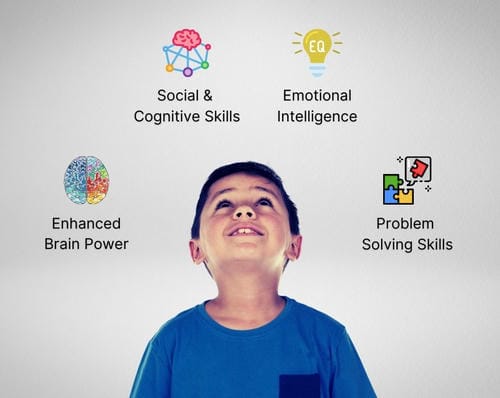
In addition to academic metrics, EI is connected to social competence and behavioral adjustment. Children with higher emotional intelligence consistently demonstrate stronger social skills, such as cooperation, communication, and empathy — competencies that lead to more positive peer relationships and fewer conduct problems. Research further suggests that emotionally intelligent children are more resilient when confronted with adversity, whether in peer interactions or in emotionally charged situations, enabling them to recover from setbacks with greater ease. Cognitive scientists also highlight that effective emotional regulation underpins better problem-solving and decision-making, illustrating how emotional and cognitive skills interact to support overall functioning. These findings reinforce the idea that EI is not siloed within the emotional domain but has cross-cutting benefits that ripple into cognitive, social, and adaptive capacities throughout development.
Another strand of evidence suggests that EI development in childhood can have enduring effects. Longitudinal research indicates that early gains in emotional competence are predictive of healthier social relationships, improved academic trajectories, and greater well-being in later childhood and adolescence. Neuroscientific perspectives also support EI development; brain regions related to emotional processing and self-regulation continue to mature throughout childhood, and intentional emotional learning experiences can scaffold this biological development, strengthening neural pathways associated with emotional control and social cognition across time. [3]
Practical Implications for Parents: What the Research Suggests
If scientific research shows that emotional intelligence is teachable and consequential, the next question for parents is how to support this development at home. Parents are uniquely positioned to shape emotional development through everyday interactions, modeling, and guided reflection. First, parents can nurture emotional awareness by helping children recognize and label emotions as they arise — a foundational step in building emotional literacy. When parents consistently use words to describe feelings (“It looks like you feel frustrated right now”), children learn a richer emotional vocabulary, enabling them to express internal states more clearly and regulate their responses. These moments of emotional labeling, grounded in responsive caregiving, build self-awareness and self-regulation skills that research identifies as core components of both EI and SEL development.
Beyond labeling, parents can practice emotional coaching — actively listening to a child’s emotional expression without minimizing or dismissing it. This coaching involves validating the child’s feelings, exploring what triggered the emotion, and collaboratively developing strategies for coping or problem-solving. Emotional coaching fosters a sense of emotional security and teaches children adaptive ways to handle distress, frustration, and conflict. Scientific perspectives suggest that children who experience this guided reflection develop both stronger self-regulation and greater empathy for others, seamlessly integrating SEL principles into everyday life. [4]
Parents can also model emotional intelligence through their own behavior. Children learn by observing how caregivers manage emotions, decipher social cues, and repair interpersonal ruptures. When parents demonstrate transparency about their own feelings, regulate strong emotional reactions, and show empathy in their interactions, they provide powerful real-world examples of EI in action. Research underscores that these modeled behaviors are internalized by children, shaping how they perceive and respond to emotional situations. Additionally, creating safe spaces for emotional expression — where children feel heard and understood — helps them build confidence in articulating internal experiences without fear of judgment.
Finally, parents can incorporate activities that encourage emotional reflection, empathy development, and perspective-taking. Engaging children in conversations about emotional experiences depicted in stories or media, practicing role-play of emotional scenarios, and encouraging acts of kindness or cooperative play all provide opportunities to apply SEL skills in varied contexts. Research affirms that these guided experiences enhance emotional awareness and social interaction competencies, helping children generalize EI skills to real-life situations. By embedding intentional SEL practices into daily routines, parents not only strengthen EI but also support broader developmental goals related to resilience, academic engagement, and relational success. [5]
Sources:
[1]: https://www.greatschools.org/gk/parenting/social-emotional-learning/the-benefits-of-sel-for-your-childs-development
[2]: https://www.allforkids.org/news/blog/the-importance-of-developing-emotional-intelligence
[3]: https://ascd.org/el/articles/emotions-matter
[4]: https://www.kidsfirstservices.com/first-insights/the-role-of-emotional-intelligence-in-early-childhood-development
[5]: https://ncdconline.org/general/95012
References
https://www.parents.com/social-emotional-learning-leads-to-higher-scores-in-math-and-reading-11839596
https://www.parentingstyles.com/child-development/emotional-intelligence
https://www.marshallconnects.com/site/corporate-growth-news/2017/05/27/emotional-intelligence-is-the-game-changer-for-children