Early Smiles: Reflective Beginnings and Social Awakening
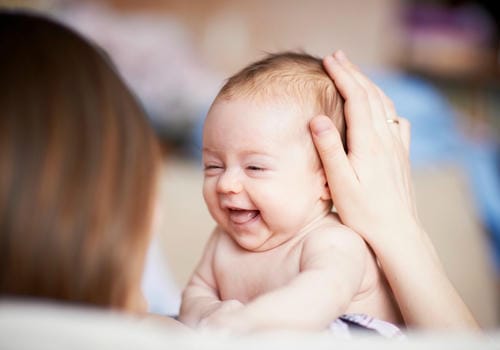
When parents first witness their newborns smile, the moment can feel deeply special and emotionally meaningful. Yet, in the earliest weeks, a baby’s smiles often do not reflect intentional communication. Newborn infants are capable of producing reflexive smiles from birth; these smiles tend to occur without external stimuli and are linked to internal states such as shifts in arousal or transitions between sleep and wakefulness. In fact, research compiled in developmental texts shows that very young infants may smile during periods like active sleep, where these facial expressions are more physiological responses than social signals.
As infants progress through the first two months of life, important changes occur in the nature of those smiles. Between roughly 6 and 10 weeks, babies typically begin to exhibit their first social smiles, which differ from reflexive grins by being triggered in response to external engagement, such as seeing a caregiver’s face or hearing a familiar voice. These social smiles emerge as neurological systems for visual tracking, face recognition, and attention regulation develop, allowing the baby to connect what they perceive with emotional expression.
The emergence of social smiling is not uniform for all infants. Often, parents report a wide range of timing for this milestone—some babies may begin smiling socially as early as 5 or 6 weeks, while others show clear, intentional smiles closer to 10 or 12 weeks. Socially shared anecdotes from parents illustrate this variability, with many observing distinct, directed smiles during interactions that appear intentional, even if initially fleeting. These real-world accounts align with the clinical understanding that developmental milestones have wide but meaningful ranges.
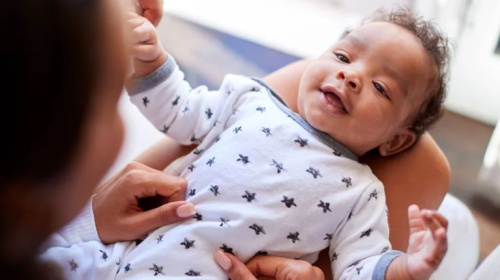
During this early phase of social smiling, infants are gradually learning not just to express positive affect but to respond to the emotional cues of others. A baby who smiles when you meet their gaze, or in response to your playful voices and expressions, is engaging in an early and foundational form of emotional communication. This indicates progress in their ability to process visual and auditory stimuli, maintain attention on social partners, and link emotional expression to social context. [1]
Beyond simple smiling, young infants begin to use facial expressions in ways that reflect early attention regulation and social responsiveness. As their vision improves, infants become better at tracking faces and interpreting emotional cues, which allows social smiles to become more contingent on the behaviors of others in shared interactions. Researchers note that this attentional evolution supports a richer, dynamic interaction between infant and caregiver that goes far beyond reflexive responses.
Anticipatory Smiling and the Growth of Emotional Communication
As infants continue through the first year, their emotional communication becomes more purposeful and socially sophisticated. A key development in this progression is the emergence of anticipatory smiling—a type of smile wherein a baby smiles at an object of interest and then maintains that smile as they shift their gaze toward another person, effectively sharing their emotional experience. This behavior typically begins to appear around 8 to 10 months of age, marking a distinct advance in social cognition and affective communication.
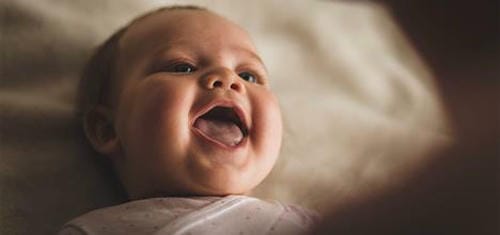
Anticipatory smiles are more than charming expressions; they represent a form of referential communication in which infants convey positive emotion about something meaningful in their environment to a social partner. Whether the baby fully understands the emotional state of the other person, or is simply learning that shared expressions result in positive social engagement, anticipatory smiles serve as early indicators of emerging social awareness.
Empirical studies support the significance of this behavior in developmental trajectories. Notably, research shows correlations between early smiling patterns (even those as early as 6 months) and later use of anticipatory smiling during joint attention episodes. These anticipatory smiles have also been linked with higher parent-rated social expressivity and social competence scores at 30 months of age, suggesting that early emotional communication has meaningful implications for later social development. [2]
The developmental increase in anticipatory smiling between 8 and 12 months underscores the infant’s growing ability to coordinate attention between objects and people—a crucial foundation for later skills such as language development, social referencing, and cooperative interaction. As infants mature, they begin to not only react to caregivers’ actions but also initiate social engagement by sharing what they find interesting or enjoyable.
The step from reactive to anticipatory smiling reflects an underlying shift in cognitive and emotional capacity: the infant begins to understand that their internal experiences can be communicated and shared with others. This early form of purposeful emotional sharing lays the groundwork for complex social behaviors that will continue to evolve throughout childhood.
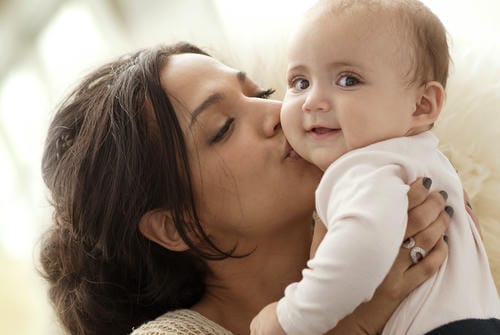
In addition to anticipatory smiling, other aspects of infant-caregiver interaction grow in complexity. For example, infants begin to integrate smiles with vocalizations, gestures, and coordinated attention. These multimodal communicative behaviors are central to the development of joint attention, a process in which both infant and caregiver are mutually aware of each other’s focus on a shared object or event—a key precursor to language acquisition.
Throughout these early stages, caregiver responses play a critical role in reinforcing and shaping infant emotional communication. When caregivers smile back, maintain eye contact, and engage in rhythmic, playful interactions, they not only validate the baby’s expressions but also provide contingencies that help the baby learn the social power of emotional communication. This responsive engagement supports the infant’s growing confidence in initiating interactions and deepens the emotional bond between caregiver and child.
For many parents, witnessing these early smiles—whether reflexive, social, or anticipatory—offers a window into their baby’s evolving emotional world. While reflexive smiles may initially seem random, the gradual shift toward intentional, socially meaningful smiling signifies profound developmental progress. These early expressions are not merely adorable moments; they are milestones in emotional communication, laying the foundation for a lifetime of social connection.
Sources:
[1]: https://www.healthychildren.org/English/ages-stages/baby/Pages/Emotional-and-Social-Development-Birth-to-3-Months.aspx
[2]: https://epublications.marquette.edu/psych_fac/164
References:
https://pubmed.ncbi.nlm.nih.gov/16467930
https://pmc.ncbi.nlm.nih.gov/articles/PMC1361265