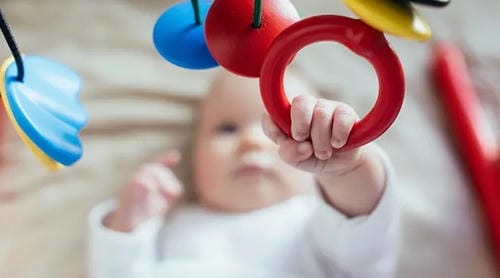
From the very first hours after birth, infants are immersed in a complex world of sensory input. Their brains are not passive receivers; instead, they actively organize information from the outside world to build neural pathways that support lifelong learning. Among the earliest sensory systems to begin functioning is touch. Research indicates that the sense of touch is the first of the five senses to develop in the womb and is foundational for early learning and social connection. When a caregiver gently holds or caresses an infant, this sensory input activates brain regions dedicated to somatosensory processing, helping newborns build awareness of their own bodies and begin to understand the connection between self and external stimuli. This early tactile experience supports the foundations of imitation and may contribute to the early development of empathy — capacities that will matter for later social interaction and emotional regulation. The neural response to touch even reflects activity not just when infants feel contact, but when they see others being touched, suggesting that early sensory experiences help infants map themselves onto the social world around them. [1]
But everyday development does not rely on one sense in isolation. Infants naturally process information across multiple sensory systems at once. Neuroscientists refer to this capacity as multisensory integration, the brain’s ability to coordinate inputs from more than one sense and interpret them as coherent events. In infancy, multisensory integration is a building block for more complex cognition. For instance, under natural conditions, infants are exposed to overlapping streams of auditory, tactile, and visual information whenever a caregiver speaks, smiles, or touches them. Laboratory research has shown that this multimodal social input enhances neural processing more than unisensory input does. When infants experience synchronous combinations of sound and touch, their neural responses are heightened and more organized, indicating that their brains are learning to integrate these inputs into meaningful patterns that will later support sophisticated perceptual, cognitive, and social functions. [2]
The Neuroscience of Early Multisensory Experiences
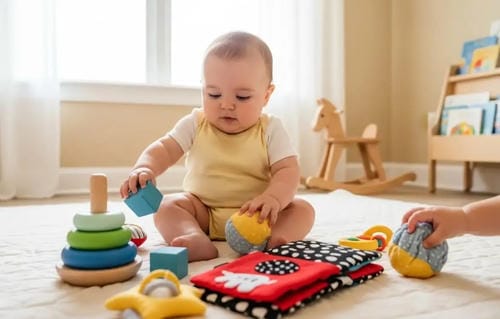
Multisensory integration does not emerge fully formed at birth, but many foundational processes appear quite early. Infants as young as a few months old begin to show evidence of coordinating sensory experiences. For example, very young infants will orient their head and eyes toward the source of a combined visual and auditory stimulus more readily than toward stimuli presented in just one modality. As they grow, their capacity for cross-modal perception expands. By four months of age, infants can match auditory and visual properties of events and by six months, they show early forms of multisensory facilitation, where the presence of information in one sensory domain enhances responsiveness in another. These early patterns of cross-modal responsiveness lay the groundwork for later abilities such as language learning, social interaction, and purposeful exploration of the environment.
The dynamic interplay of sensory information also means that infants’ brains are exceptionally responsive to the patterns and redundancies that arise when sensations coincide. When caregivers provide consistent combinations of touch, sound, and movement, infants’ brains learn to expect associations among these modalities. In research studies where infants experienced predictable sequences of tactile and auditory input at the same time, they learned auditory patterns more readily than when the tactile input did not align with sound. These findings suggest that social touch does more than provide comfort: it acts as a scaffold that supports learning in other sensory domains.
How Multisensory Bonding Shapes Development in Daily Life
In everyday caregiving, touch, sound, and movement are deeply intertwined. When a parent picks up a baby, holds them close, and speaks or sings, the infant is receiving simultaneous tactile, auditory, and often visual information. This intersensory redundancy — the repetition of information across senses — captures and sustains the infant’s attention. That sustained attention is not simply a matter of focus; it drives neural activity that strengthens emerging connections between sensory and cognitive systems.
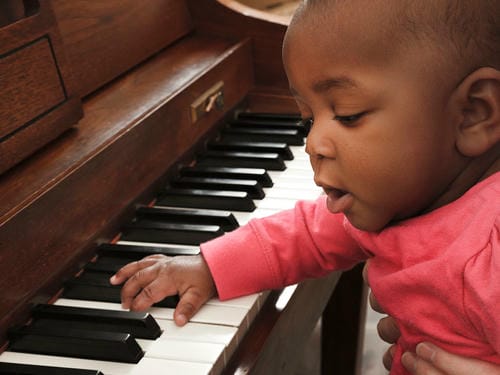
Caregivers can leverage this natural integration in simple ways. Talking and singing to infants while holding or rocking them ties together auditory and tactile experiences with vestibular and proprioceptive information (the sense of body in space). Music and rhythmic speech, in particular, involve complex patterns of sound and timing that engage multiple neural systems. When infants are rocked to a lullaby or bounce in rhythm to a song, their auditory systems process the melody and rhythm while their motor systems register the movement, and their emotional centers respond to the calming or playful tone of caregiver interaction. This multilayered stimulation supports early language development by exposing infants to phonetic patterns, intonation, and rhythm — the building blocks for later speech and communication skills — while also enhancing motor coordination and sensory integration more broadly. [3]
Movement itself is a potent source of multisensory learning. Infants engage in spontaneous motion — kicking, waving arms, turning heads — even before they can sit or walk. These self-generated movements provide the infant’s nervous system with feedback about cause and effect: when the infant moves, the world around them changes in predictable ways. This sensorimotor feedback loop not only teaches the infant about their own body, but also reinforces neural circuits that underlie intentional action and exploratory behavior. When these spontaneous movements are embedded within social routines — such as swaying during a lullaby or reaching for a caregiver’s face during play — the experiences become even richer. The caregiver’s voice, facial expressions, and tactile contact frame the movement within a social context, providing additional multimodal cues that reinforce learning and attachment.
The effects of multisensory bonding extend beyond immediate physiological and perceptual responses. Studies examining mother–infant interactions using neurophysiological measures such as electroencephalography (EEG) have found that infants show greater neural engagement during interactions that involve multimodal input. In one line of research, infants exhibited increased markers of neural readiness and engagement when participating in interactions that combined parent behavior with simultaneous sensory cues, compared with interactions that presented unisensory input. This suggests that infants are neurologically tuned to respond more robustly when caregiving is multisensory, highlighting the deep connection between naturalistic parent–child interaction and infant brain development.
In the context of social and emotional development, multisensory experiences also play a formative role. Touch, in particular, is a powerful social signal. Affectionate physical contact from caregivers activates neural pathways that are linked to emotional regulation and social perception. When infants receive gentle touch in synchrony with soothing speech or eye contact, they not only feel comforted but also begin to associate these sensations with safety and social connection. Over time, these early patterns of interaction help infants build expectations about relationships, fostering trust and attachment that form the basis for later emotional resilience.
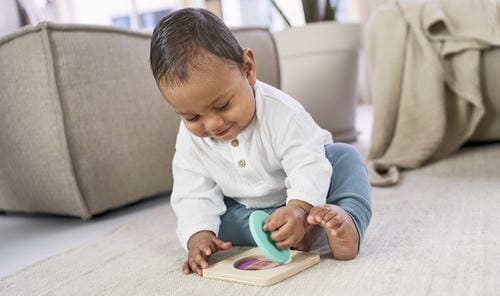
As infants grow, the nature of multisensory integration continues to evolve. For example, their ability to use multiple sensory streams to support learning becomes increasingly sophisticated over the first year of life. Between three and six months of age, infants show growing capacities to process and integrate audiovisual information in ways that support recognition of rhythm and tempo, visual matching of sounds to actions, and early communication cues. These capacities emerge through repeated exposure to coordinated sensory experiences, such as hearing a caregiver’s voice while seeing their lips move and feeling their warm embrace.
The cumulative impact of these early multisensory experiences is profound. Neuroscience research shows that the brain’s architecture in infancy is highly plastic — meaning it changes rapidly in response to experience. Neural connections that are frequently activated become stronger, while those that are not used are pruned away. In this sense, the multisensory environment an infant experiences every day — the voices they hear, the touches they feel, the movements they make — help shape the very structure of their brain. Environmentally driven neural development is not simply about exposure to stimuli, but about the patterning and quality of that exposure. When caregivers provide rich, predictable, and responsive multisensory experiences, they support the neural foundations for language, motor skills, cognitive abilities, and emotional health. [5]
For parents, understanding the importance of multisensory input can inform everyday caregiving practices. Simple, intentional moments — such as singing during routine care, responding to an infant’s vocalizations with eye contact and gentle touch, or engaging in playful movement that aligns with sound — are not just comforting, they are building the neural infrastructure upon which later learning depends. Multisensory bonding is not a specialized technique reserved for formal interventions; it is embedded in the ordinary rhythms of caregiving. By recognizing and responding to the ways infants naturally integrate sensory information, parents can support robust early brain growth through the very acts of holding, talking, moving, and engaging with their child.
Sources:
[1]: https://www.sciencedaily.com/releases/2018/01/180116144027.htm
[2]: https://pubmed.ncbi.nlm.nih.gov/29253738
[3]: https://www.family.abbott/sa-en/similac/articles/cognitive-development/impact-of-music-on-infant-child-brain-development.html
[4]: https://www.johnsonsbaby.com.my/pediatric-healthcare-professionals/multisensory-stimulation-baby-development
References:
https://openstax.org/books/lifespan-development/pages/3-3-sensory-development-in-infants-and-toddlers
https://www.mdpi.com/2076-3425/9/7/153